Affichage des articles dont le libellé est Massive_Mimo. Afficher tous les articles

mardi 19 mai 2020

thumbnail

What is ACTIVE ANTENNA UNIT and what are its benefits from 5G user experience perspective ?


An active antenna is an antenna that contains active electronic components like antenna-integrated radio designs place the RF module next to the passive antenna to reduce cable losses.
Active Antenna does not need to be merely passive elements. With intelligent integration, active antenna technology transforms traditional antenna to contribute to base station efficiency. This enables operators to significantly increase the capacity and coverage targets set for their network.
As a base station system evolved, the AAS integrated the active transceiver array and the passive antenna array into one radome.

In normal mode, RRH is connected to Antenna through RF cable. So there are two different units (one is RRH and second is antenna) , on the other hand, AAS is altogether single unit where different antenna elements has their own RF transceiver chains integrated.
AAS is integrated into the antenna so as to offer possibilities for finer grained digital control of the beamforming weight of each individual subelement within the antenna.


2D Vs 3D Antenna

AAS are introduced with 16 ports antenna (8 beams), before it we talk about passive 2D antenna. Its 3D-MIMO technologies fully utilize radio resources in both the micro- and macro-spatial domains.

3D Aspect of AAS
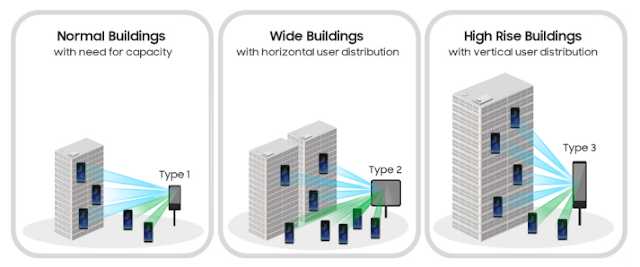

Traditionally and still, evaluations in the wireless communication field use channel models with only two dimensions, even though we live in a three-dimensional world. The vertical direction is basically non-existent in these models, all UEs are assumed to be placed on ground-level.

UE specific elevation beamforming is one key technique that we are exploring in the context of 3D channel models. It allows a beam to be directed in a way that suits each individual UE in the cell. For example, a UE high up in a high-rise may desire a beam pointing upwards, while a UE on the ground level may get a downwards pointing beam.

MU-MIMO


The term MIMO usually refers to Single User MIMO (SU-MIMO). In Single User MIMO, both the base station and UE have multiple antenna ports and antennas, and multiple data streams are transmitted simultaneously to the UE using same time/frequency resources, doubling (2×2 MIMO), or quadrupling (4×4 MIMO) the peak throughput of a single user.

In MU-MIMO, base station sends multiple data streams, one per UE, using the same time-frequency resources. Hence, MU-MIMO increases the total cell throughput, i.e. cell capacity. The base station has multiple antenna ports, as many as there are UEs receiving data simultaneously, and one antenna port is needed in each UE.

The performance potential of beamforming techniques tends to increase with an increasing number of antennas, since the baseband gets access to more degrees of spatial freedom. This is facilitated by techniques for active antenna systems (AAS) where the radio is integrated into the antenna so as to offer possibilities for finer grained digital control of the beamforming weight of each individual subelement within the antenna.

AAS for 5G


Massive MIMO is the back-bone for 5G network where 100 or more antenna elements are to be used for various benefits. But it is difficult to introduce massive-elements antennas (100 or more elements) that are required for massive MIMO into traditional base stations, attaching over 100 RF cables between each antenna element and RF TRX unit seems unrealistic and adding more RF losses. Using an AAS that combines the antennas, and RF TRX unit (transmitter and receiver chains), into one unit would be an effective way to resolve these issues.

In addition to the conventional roof top mounting locations, small cells are expected to cover shopping malls, Stadiums, food canteens, or different premises. To be effective, AAS/MIMO must be able to flexibly adapt to each individual small cell user’s distribution environment, so optimum antenna structure can be offered for any individual situation in terms of the number of vertical and horizontal antenna elements and the number of independent transceivers, adding huge efficiency to the network.

AAS BENEFITS

• Improved spectral efficiency and network capacity for higher throughput. The system sends and receives multiple data signals over the same radio channel, which increases the spectral efficiency per cell and the number of users who can be served simultaneously. This raises the peak and average cell throughput more cost-effectively than other techniques, such as new spectrum or additional sites.
• Stronger signal and reduction of interference for better coverage. Beamforming provides accurate and
narrow beams through aiming of the signal, which reduces interference and improves signal quality,
especially at the cell edge. Beamforming allows for expanded reach of the cell compared to traditional
antennas. This is particularly true for higher frequencies where beamforming compensates for the higher path loss.


dimanche 17 mai 2020

thumbnail

New Radio For 5G


5G New Radio (NR) is the global standard for a unified, more capable 5G wireless air interface. It will deliver significantly faster and more responsive mobile broadband experiences, and extend mobile technology to connect and redefine a multitude of new industries.

5G has the business world abuzz with its possibilities. It’s expected to provide the connectivity that powers everything from autonomous cars to humanoid robots to smart homes. According to research, 70 percent of companies plan to have 5G use cases in production by 2021, with public transport, safety, agriculture and energy leading the way. So what are some of the most compelling use cases ?

The 3GPP specification for 5G states that the first roll-out of 5G networks and devices will be brought under Non-Standalone (NSA) operation, which is to say that the 5G networks will be supported by existing 4G infrastructure. Thus, 5G-enabled devices will connect to 5G frequencies for data user plane but will still use 4G for control plane such as signaling.


Single Framework, Multiple Usage Scenarios

The new radio (NR) specification targets a single technical framework addressing all usage scenarios, requirements and deployment scenarios including for enhanced mobile broadband (eMBB), massive machine-type-communications (mMTC) and ultra-reliable and low latency communications (URLLC).

Enhanced Mobile Broadband (eMMB)


The first roll-out of 5G wireless network will focus on enhanced mobile broadband (eMBB) to provide higher data-bandwidth and connection reliability via two NR frequency ranges:
  • Range 1 extends 4G LTE, from 450 MHz to 6,000 MHz. These bands are specified from 1 to 255 and this is mainly referred to as New Radio (NR) or sub-6GHz.

  • Range 2 is at a much higher frequency 24,250 MHz (~24GHz) to 52,600 MHz (~52GHz). These bands are specified from 257 to 511 and this is referred to as millimeter wave (mmWave).


Fixed Wireless Access (FWA)

Mobile service providers can use 5G to deepen their customer relationships, and extend into the home and workplace:
  • 5G enables home broadband, fast enough for gaming and high-definition video streaming.
  • 5G can also connect small and medium sized businesses, giving them guaranteed reliability for their business-critical applications.

Smart Stadiums

Service providers can sell new 5G services to venues, enabling them to:
  • Offer live 8K video from the pitch or the stage, with fans able to choose from multiple camera angles in real time.
  • Show data overlays and stats about musicians or players on the audience’s mobile or wearable devices.
  • Sell merchandise or additional services on the fly to customers using mobile devices.
  • Support pop-up retailers with secure wireless connections for payment processing.
  • Extend market reach, by offering the same live video and information feeds to fans who couldn’t get to the venue.


URLLC


        Ultra-reliable, low latency communications (URLLC) covers an entirely new use case family by supporting new requirements from vertical industries such as autonomous driving for the automotive industry, remote surgery for eHealth and cloud robotics for Industry 4.0. All applications demand:
  • Improved latency
  • Improved reliability
  • Higher availability
  • Higher security


The design of a low-latency and high-reliability service involves several components: Integrated frame structure, incredibly fast turnaround, efficient control and data resource sharing, grant-free based uplink transmission, and advanced channel coding schemes. In URLLC communications, < 1 ms latency is required to support demanding applications. That's why the designing of physical layer will be the most challenging thing as satisfying low latency and ultra-high reliability - two conflicting requirements at the same time is not an easy task. To fill this need , 5G NR introduces a flexible numerology to enable a wide range of frequencies and scheduling of diverse services that can be high throughput, low-latency, or even high latency for IoT applications. 
To ensure that , a scalable sub-carrier spacing is introduced by 5G , it enables scalable slot duration so that more slots can run in less time. To support future low-latency, mission-critical applications, a mini-slot is shorter in duration than a standard slot and can start at any time without waiting for the start of a slot boundary.

5G Possible Numerology


Massive Machine Type Communication (mMTC)


       Massive machine type communication (mMTC) also known as massive machine communication (MMC) or massive Machine to Machine communication is a type of communication between machines over wired or wireless networks where data generation, information exchange and actuation takes place with minimal or no intervention from humans. It is a sub-classification of machine type communication (MTC). mMTC deals particularly with wireless connectivity and networking amongst massive numbers (billions) of machines and is considered a key progression from the Internet of Things IoT to the Internet of Everything.


The development of mMTC is limited by the availability of the connectivity necessary to support vast numbers of machine to machine interactions. This type of communication is typically via small data packets which are not optimally supported by the cellular networks designed for human communication. Such networking would have to be secure, reliable and consistently scalable with high capacity and low latency to support a range of communications at varying frequency bands. mMTC also needs to have low cost and energy consumption with the penetration needed to function effectively in dense urban or indoor environments.